Give One Big Plant Room to Work
Some rooms have all the useful pieces and still feel a little undecided. The sofa is there, the rug is there, the coffee table is doing its coffee table duties, yet the far corner looks as though it missed the meeting. It is easy to answer that feeling with more objects. Often, one large plant is the better answer.
A tall or full plant gives the eye somewhere to land. It adds height beside low furniture, softens hard edges and fills floor space that would otherwise sit empty. The trick is giving it enough room to read as a feature. If it has to squeeze between a chair, a lamp and three baskets, it starts to look like it is waiting to be moved.
I like a large plant when it feels like part of the room's arrangement, with a shape and a job of its own. A good one can hold a corner, frame a sofa or make the distance between a window and a reading chair feel less bare.
Choose the Shape Before the Name
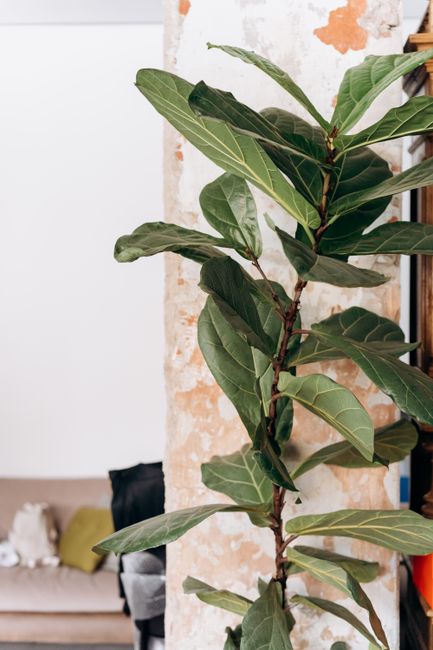
For height. Bird of paradise, palms and fiddle leaf figs send the eye upward. They suit a room with enough ceiling height and an empty stretch of wall where their outline can be seen. A tall plant under a low ceiling can feel crowded, while the same plant beside a high window can make the whole room feel more balanced.
For a broad, softer outline. A mature monstera has split leaves and a spreading habit that can soften clean lines around a sideboard or a sofa. It needs room for its leaves and, with support, can grow toward ceiling height. A rubber plant gives a more upright, contained shape, with dark leaves that catch the light and a strong central stem.
For a narrow place. Dracaenas and large snake plants have an upright form that works where a broad canopy would get in the way. They can bring a little structure to a slim corner without asking the room to rearrange itself around them.
Put the Plant Where It Can Be Seen and Grow
Start with the light. The most beautiful corner is not useful if it is too dark for the plant you bring home. Fiddle leaf figs and rubber plants prefer bright indirect light. Bird of paradise wants as much bright light as possible and is happier close to a south or west window. Monstera can tolerate medium indirect light, while dracaena can handle lower light. Match the plant to the light you have before choosing the place where it would look nicest.
Leave some breathing room. Large leaves need space to fill out. Keep a plant around 12 to 18 inches from upholstered furniture so its leaves do not rub against the sofa and watering does not become a wrestling match. A plant set slightly away from the wall also looks placed with intention instead of wedged in after everything else was finished.
Use corners with a purpose. A corner can make a natural frame for a large plant, especially if the canopy reaches partway up the wall. Beside the end of a sofa, the plant can give the seating area a taller edge. Near a window, it links the room to the view outside and gets the light it needs. These are all useful positions, but they are not interchangeable. The plant still has to suit the conditions.
Let One Plant Be Enough
A large plant often looks strongest standing alone. When its leaves and shape have room to show, surrounding furniture can stay simple. A side chair, a sofa or a low cabinet is usually enough company. Too many small pots, tables and decorative objects around its base weaken the effect and make the area busy.
If a collection is already part of the room, use different heights rather than lining every pot across one surface. A floor plant, a stand and a trailing plant on a shelf can make the arrangement feel less flat. Still, the large plant should keep a little clear space around it. It is there to give the room a focal point, not to disappear into a crowd.
The pot helps finish the picture. A heavy ceramic, concrete or terracotta pot can steady a tall plant and put visual weight at its base. A woven basket or textured planter can make a bold plant feel more relaxed. Whatever you choose, drainage matters. A decorative container without drainage can hold excess water around the roots, so it can be easier to keep the plant in its nursery pot, water it separately and let it drain before returning it to the outer pot.
Keep the Feature Looking Like a Feature
Big leaves gather dust, and dust reduces the light that reaches them. A wipe with a damp cloth keeps the foliage looking clean and gives you a chance to see whether there are pests or damaged leaves. Rotate the pot a quarter turn every week or two if it is leaning toward the window, so the canopy has a chance to grow more evenly.
Large plants are heavy, especially once the potting mix has been watered. Pick a stable, wide based pot and think about the weight before putting one on furniture or a delicate floor. Check the drainage hole each spring. Roots growing out of it or water rushing straight through can mean the plant has outgrown its pot. When it is time to move up, a pot just one or two inches wider is enough.
A large plant works best when it has the right light, a little clear floor around it and a shape that suits the room. Give it that much, and it can do more for a quiet corner than a whole extra layer of decoration.